Most backyard improvement articles cover the same territory. New patio furniture, a fresh deck stain, a pergola, raised garden beds. Those suggestions are not wrong, but they have been written about enough that most homeowners have already weighed them and moved on. This list goes somewhere else entirely.
These are the upgrades that tend to get skipped in standard roundups, not because they are difficult or expensive, but because they are specific enough that a general article never quite lands on them. A few cost very little. Some are weekend projects. A couple require a professional. All of them make a measurable difference in how a backyard looks, functions, or feels, and they are well suited to the way outdoor space gets used in Blue Springs, where summers run hot and humid, spring brings some of the wettest months of the year, and a backyard that works well in July looks and functions very differently from one that just looks good in a photo.
1. Paint the Fence a Color That Makes a Statement
Cedar stain is the default fence finish, which means it reads as background in nearly every yard that has it. A fence painted in deep charcoal, muted olive, washed-out black, or warm terracotta stops being invisible and starts being a design choice, and that single shift changes how everything else in the yard reads against it.
A darker fence makes plantings look more vivid and gives furniture a stronger visual anchor. Think of it like an accent wall: you are not changing the whole room, just the surface that makes everything in front of it more intentional. In Blue Springs neighborhoods where the same fence style runs from yard to yard through subdivisions built in the nineties and early two-thousands, a color choice is one of the fastest ways to make a property feel distinct without changing its footprint. This works best on a fence that is structurally sound but visually flat, which describes a lot of fences in this area that are still doing their job but have gone gray and unremarkable over the years.
2. Create a Second Place to Sit
If the backyard only has one gathering spot, it is going to feel smaller and less useful than it is. The deck or patio behind the house handles everything by default, from morning coffee to weekend dinners to evening conversation, and a single zone limits how the yard gets used across the day.
In Blue Springs, where July afternoons regularly push into the upper eighties with humidity that makes it feel closer to the mid-nineties, the main deck behind the house can become genuinely uncomfortable between noon and five. A second seating area in a shadier back corner, even just two chairs and a side table on a simple gravel pad or a handful of flat pavers, creates a spot that is usable during the hottest part of a summer day. The yard starts to feel like it has more than one setting, and people naturally spread out rather than clustering in the same spot every time.
3. Turn the Space Under the Deck Into a Room
If there is an elevated deck on the property, there is almost certainly usable square footage directly beneath it going to waste. That area is already covered by the deck boards above, already shielded from direct sun, and already has structural framing overhead. The problem is that without a ceiling system below the joists, water drips through freely, the space looks unfinished, and anything stored there eventually gets wet.
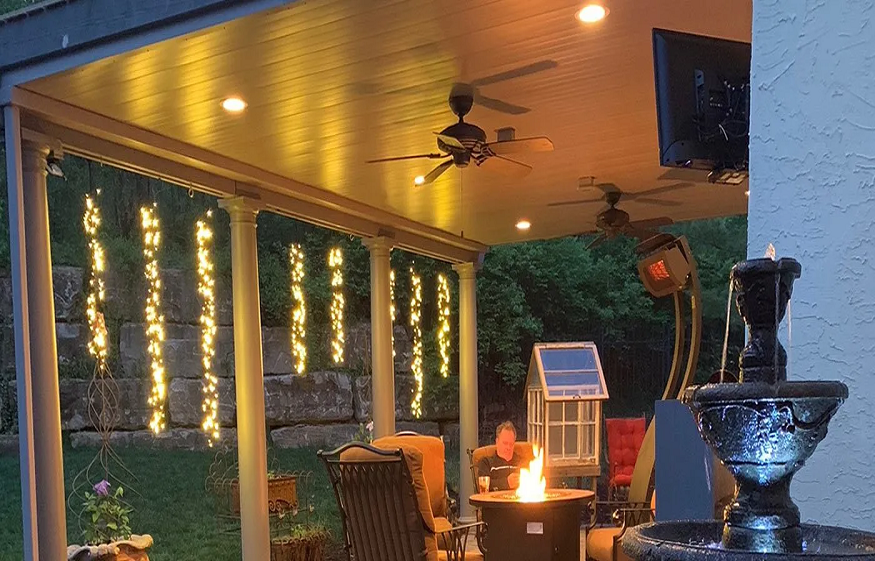
An under-deck ceiling system solves all of that in one project. It installs beneath the joists, channels water away through an integrated drainage system, and converts what was a neglected gap into a dry, finished space ready for lighting, a ceiling fan, or a heater. No new construction, no added footprint, no permit for square footage that does not exist yet. The footprint is already there, and the ceiling is simply what makes it function like a room.
In Blue Springs, where May alone averages over four inches of rain and spring storms can drop a significant amount of water in a short window, an open under-deck area creates a real drainage and storage problem that a ceiling system solves at the same time as it creates usable space. A ceiling fan installed in that covered area also makes the space viable on humid summer evenings when a breeze makes the difference between staying outside and going in.
4. Build a Berm Along a Flat Fence Line
A flat planting bed along a fence has a visual problem that more plants rarely solve. Everything sits at the same height, and the result reads as a row rather than a landscape. A low berm, somewhere between twelve and twenty-four inches at its peak, introduces topography, movement, and depth that a flat bed simply cannot produce.
Layer it deliberately, starting with taller ornamental grasses or shrubs at the back for height and movement, flowering perennials in the middle that come back each year and fill in over time, and low ground cover at the front edge that spills naturally toward the lawn. Native Missouri plants like coneflower, black-eyed Susan, and little bluestem grass work particularly well in this kind of layered planting because they are adapted to the region’s heat and rainfall patterns and establish faster than non-native alternatives. Little bluestem in particular holds up through Blue Springs winters and turns a warm copper color in fall that looks intentional rather than seasonal. Keep the shape gradual rather than abrupt, and make sure soil stays well clear of fence boards so wood has room to breathe.
5. Swap Struggling Grass for Ground Cover
There is almost always at least one spot in a Blue Springs yard where grass refuses to cooperate. Under a tree where roots outcompete it for water, along a fence line where the mower never quite fits, the strip beside the gate that turns muddy every spring after a heavy April or May rain. Throwing more seed and water at those areas is a reliable way to spend money without seeing results.
Ground cover is a more practical answer, and the options are more interesting than people expect:
| Plant | Best For | Notable Trait |
| Creeping thyme | High-traffic areas | Smells good when stepped on |
| Clover | Sunny open patches | Fixes nitrogen, draws pollinators |
| Ajuga | Shaded fence lines | Deep purple foliage, spreads readily |
| Sedum | Dry slopes | Survives almost anything |
| Irish moss | Stepping stone gaps | Dense and stays green |
All of these hold up well in Missouri’s mix of humid summers and cold winters, which eliminates a lot of the guesswork around whether they will come back in spring. Start with the single worst patch rather than overhauling the whole yard at once and let the result prove itself before expanding.
6. Build One Private Spot
A yard can feel exposed even when a full fence surrounds it. In Blue Springs, where a lot of the housing stock sits on lots close enough together that a neighbor’s second-story window has a clear line of sight into the main outdoor seating area, that feeling is common and specific. The problem is rarely the whole perimeter. It is usually one angle, one window, one sidewalk view that makes the deck feel less comfortable than it should.
Addressing that one spot tends to change how the whole yard feels without touching anything else. Stand where people spend the most time and look around from that exact position, because the sightline from the center of the lawn is rarely the one that matters. Privacy improvements that tend to have an outsized effect include a taller fence section behind the main seating area, a lattice panel with a climbing vine along the deck edge, a freestanding screen angled to block the specific view that bothers people, or a dense planter arrangement that softens the line without hard construction.
Read More: Is Your Air Conditioner Beyond Repair? Signs It’s Time for an Upgrade
7. Plant Something That Smells Good
Scent is almost entirely overlooked as a dimension of backyard design, which makes it one of the more effective ways to make a yard feel different from every other yard on the street. In Blue Springs, where summer evenings stay warm and humid well past sunset, fragrant plants have a longer window to do their work than they would in a drier climate. Good candidates include jasmine near the seating area, a lavender border along the main path, rosemary in a large pot near the grill, or a gardenia near the back door that registers every time someone steps outside in the evening.
Concentration matters more than variety here. One well-placed fragrant plant does more than five modest ones scattered around the yard, and Missouri’s warm nights mean that scent lingers longer than it would in a cooler or drier region. A yard that smells good at dusk becomes a yard people want to spend time in at dusk, and that association builds each season.
8. Swap a Downspout for a Rain Chain
A downspout does its job without drawing any attention to itself, which is fine functionally but misses an opportunity. A rain chain handles the same drainage task while becoming a small feature worth noticing. Water moves down a series of linked cups or rings rather than rushing invisibly through a metal tube, and the sound it produces changes how rain feels in the backyard.
In Blue Springs, where June is the wettest month with an average of nearly six inches of rainfall and spring storms can be significant, the bottom of the chain needs to drain somewhere responsible. Good options include a decorative basin of river rock, a rain barrel connected to the garden, a planted rain garden along the fence line, or a dry creek bed that carries runoff away from the foundation. That drainage destination often becomes its own quiet feature. A dry creek bed that follows the yard’s natural drainage path looks considerably more deliberate than it is, solves a real problem, and gives the eye somewhere interesting to land near the fence line.
9. Lay a Path to Somewhere Worth Going
A yard without a defined path gets crossed in straight lines toward whatever the destination is. A stepping stone path that leads somewhere specific, a back corner seating area, a garden bed, a fire pit, gives the yard a sense of organization and draws people into the space rather than leaving them standing near the house looking across it.
The destination matters more than the path materials. A path that leads to a bench under a shade tree, a small kitchen garden, or the far end of the yard where nobody currently goes creates a reason to walk there, and that changes how the yard gets used day to day. Good material options for Blue Springs yards include flagstone for a natural irregular look, limestone for a cleaner more formal feel, reclaimed brick for warmth and character, and concrete pavers for the most durable and consistent option. All of them hold up well through Missouri’s freeze-thaw cycles when set on a proper base.
10. Layer the Lighting Instead of Adding More of the Same
Most backyard lighting floods down from a fixture on the house or washes outward from a single source, and the result tends to feel flat and functional rather than warm or inviting. Underlighting works from the opposite direction and produces a result worth understanding before buying any new fixtures.
Placing light sources beneath deck rails, along stair risers, under planter boxes, and along the bottom edge of fence boards makes the yard glow rather than appear lit. Shadows fall upward. The fence takes on texture that disappears under overhead light. Plants near the fence look more dimensional at night than they do during the day. In Blue Springs, where summer evenings are warm enough to stay outside well past dark from May through September, the quality of the lighting matters more than people account for because the yard gets used in the dark for a significant portion of the year.
String lights add something different, which is a defined overhead plane that changes the perceived scale of the space. A strand of warm bulbs stretched taut from the house to a fence post at nine or ten feet turns what feels like an open area into something that reads more like a room. Pull the strand taut rather than looping it loosely, and prioritize height over density. Together, underlighting along the structural elements and string lights overhead layer the yard in a way that a single fixture type never quite manages on its own.
Read More: Top Benefits of Installing Retractable Insect Screens
11. Improve the View From Inside the House
Some of the best backyard upgrades register before anyone steps outside. The kitchen sink, the dining table, the back door, the family room window. Those are the views of the backyard that get seen every single day, often far more frequently than the yard itself gets used. A leaning fence panel, a pile of hose, a faded deck board, or a blank wall visible from the kitchen makes the yard feel unfinished before the sliding door opens.
In Blue Springs, where winters are cold enough that outdoor use drops off significantly from November through March, the view from inside the house is the primary way the backyard registers for roughly five months of the year. Improving that sightline pays off constantly rather than occasionally. A few changes worth making include placing a large planter where it reads well from the kitchen window, adding a trellis against the fence that frames the main view from inside, moving clutter out of the primary sightline entirely, upgrading the single fence section the eye lands on first, and adding a warm light near the deck that glows visibly after dark from inside. The view just needs to give the eye somewhere pleasant to land, something green, something lit, something that reads as tended rather than neglected.
Start With Whatever Is Bothering You Most
The upgrades that make the biggest difference are almost always tied to a specific frustration. A view that bugs you every time you look at it, a corner that never gets used, a gate that resists every time, a fence that looks tired, a space beneath the deck that drains onto everything stored there. Those friction points are where the investment goes furthest, and in most Blue Springs backyards, at least one of them is already on the list. That is usually the right place to start.