
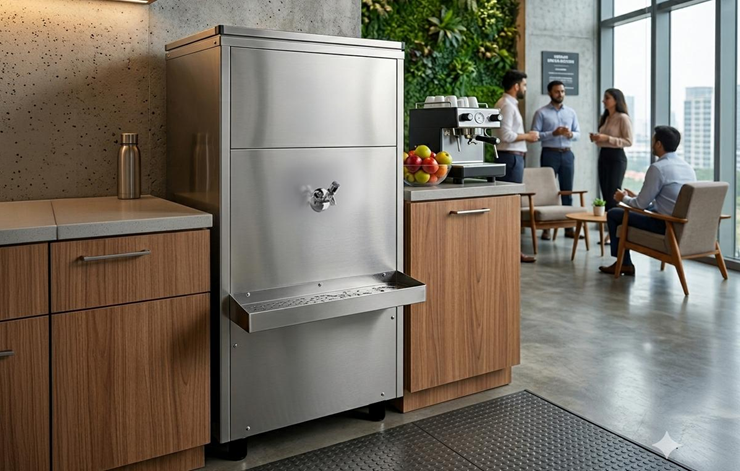
In any shared commercial space, a storage water cooler with a built-in purifier is the simplest way to guarantee clean, cool drinking water around the clock. For business owners comparing options, figuring out whether a higher water cooler price is worth it comes down to calculating total lifetime costs. Premium units may cost more initially, but their heavy-duty construction and lower long-term costs can make up for it.
What Drives the Water Cooler Price?
The price of a water cooler is contingent on some key features that influence both the initial investment and the unit’s operational reliability.
Material Grade and Heavy-Duty Construction
Continuous, heavy daily usage in commercial spaces causes rapid wear on lower-grade plastic or thin sheet-metal housing. High-performance water coolers feature food-grade stainless steel tanks and bodies. Stainless steel offers exceptional hygiene, structural durability, and high resistance to corrosion, preventing rust and leakage over years of constant operation.
Integrated Purification Technologies
Basic water coolers only chill incoming water, meaning they require separate filtration systems. Storage water coolers with inbuilt purifiers combine multi-stage purification directly inside the unit:
- RO (Reverse Osmosis): Essential for treating water with high Total Dissolved Solids (TDS), removing dissolved salts, chemicals, and heavy metals.
- UV (Ultraviolet): Guarantees microbiological safety by inactivating bacteria and viruses.
- Active Copper Zinc Technology: Select advanced units feature active copper infusion, adding controlled amounts of copper ions to improve overall mineral quality.
High-Capacity and Pre-Assembled System Integration
In large-scale industrial operations, schools, hospitals, or food processing units, standard cooling units must process massive volumes of water. In these high-demand settings, standard coolers need to be paired with larger water supply systems, such as a 500 lph RO plant.
Many high-capacity commercial purifiers use skid-mounted designs. A skid-mounted RO plant is a pre-assembled reverse osmosis system that comes pre-wired and pre-piped. This includes pre-treatment modules and UV filtration directly on the skid. This is a great choice to reduce installation time and upfront labor costs.
Calculating ROI on Water Coolers
Looking strictly at the sticker price rarely gives you the full picture. To figure out the real return on your investment, you need to consider the following:
The Hidden Costs in Budget Coolers
Inexpensive commercial units often cut corners on insulation and use basic compressors. Over time, those cheaper parts work harder and pull more electricity just to keep the water cold.
Read More: Boutique Tile Ideas That Bring Character to Interior Spaces
On top of higher power bills, low quality spare parts are much more likely to leak, lose refrigerant, or break down when you need them most.
Operational and Installation Savings
Higher-priced systems use efficient compressors and thick insulation. This keeps water cold continuously while using less energy. If you manage a larger facility, choosing a pre-assembled water cooler saves time and hassle. Since these units arrive pre-wired and pre-piped, installation is quick and requires minimal plumbing changes on site.
Maintenance, Service Cycles, and Warranties
Most commercial water coolers need routine servicing, depending on your water quality and usage. Buying from a trusted brand gives you access to a reliable service network. That means genuine spare parts, fresh filters, and replacement RO membranes are easy to source. Strong warranty coverage protects your purchase and keeps the system running smoothly for years.
Matching Capacity and Investment to Your Needs
The goal is not to buy the most expensive water cooler available. It is about matching the capacity and filtration level to your actual daily demand.
Low-Footfall Environments
If you are outfitting a small breakroom, a private office, or a satellite branch with light daily use, a compact water cooler with around 15-liter storage tank is usually enough. Basic UV filtration or standard RO gets the job done without forcing you to overspend on extra capacity you will not use.
High-Footfall Commercial Settings
Factories, schools, hospitals, hotels, and food processing plants need heavy-duty equipment. These busy environments require storage capacities of 80 liters, 100 liters, or more, alongside high-volume purification systems. Investing in a high-capacity water cooler of around 120L storage and 80LPHensures your unit handles constant daily crowds.
To Conclude
If you run a small office with light daily use, an entry-level model is more than enough to get the job done without overspending. But if you are managing a busy floor with high foot traffic, investing more upfront will save you money in the long run. The best approach is simply to look at your daily water usage, test your water quality, and pick an option that fits both your budget and long-term plans.
Read More: Ways to Give Your Kitchen a More Distinctive Look in Williamsburg, IA
